Critter-of-the-Month
July 2026
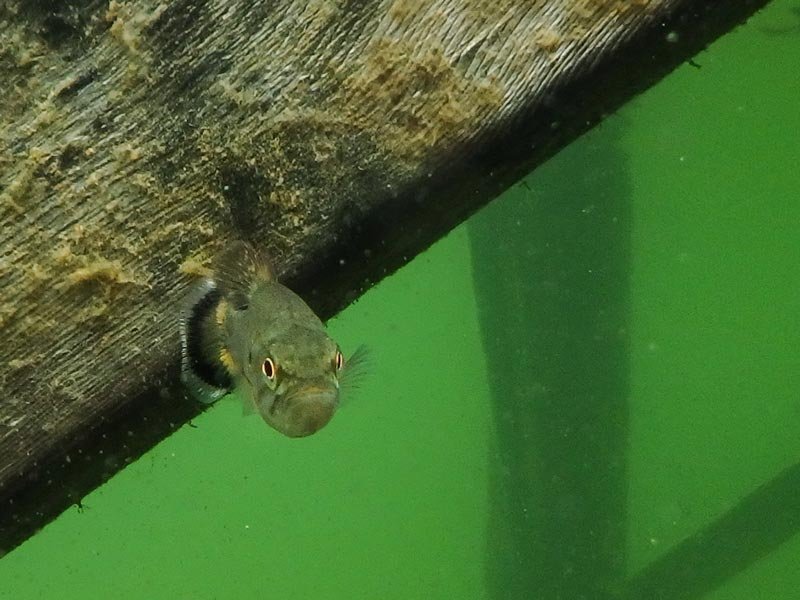
Dock Spider
(also known as Fishing Spider, Wharf Spider or Raft Spider)

FERNS OF THE HALIBURTON HIGHLANDS
Stay tuned for the Spring 2026 Edition of The Informer:
Ferns of the Haliburton Highlands: Forest Treasures of Boshkung Lake
Nestled in the rolling forests and granite shield of the Haliburton Highlands, Boshkung Lake is not just a haven for swimmers, boaters, and birds. Beneath the trees and along its shaded shorelines lies a quietly fascinating community of plants that have existed since before the age of dinosaurs — the ferns . . . .
Field Identification Guide:
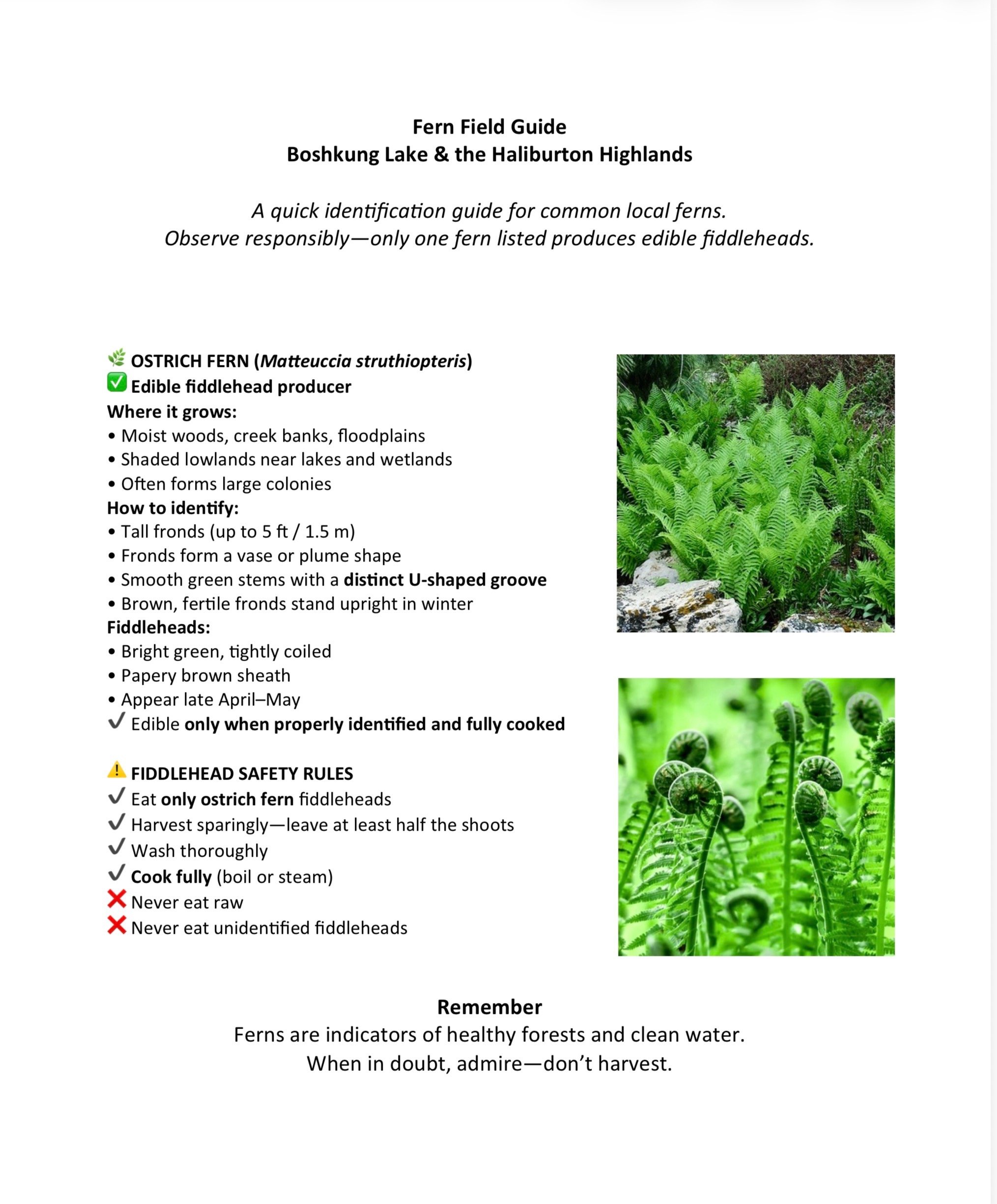
In the meantime, here’s a short Field Guide to assist you in identifying the common ferns found near Boshkung Lake.
Keeping in mind that only one fern noted is an edible fiddlehead producer, the Ostrich Fern (Matteuccia struthiopteris).
Common Ferns Found Around Boshkung Lake

🌿 OSTRICH FERN (Matteuccia struthiopteris)
✅ Edible fiddlehead producer

🌿 LADY FERN (Athyrium filix-femina)
⚠️ Not recommended for foraging

🌿 SENSITIVE FERN (Onoclea sensibilis)
❌ Not edible

CLICK PHOTOS TO ENLARGE
🌿 WOOD FERN (Dryopteris species)
❌Not edible

🌿 CHRISTMAS FERN (Polystichum acrostichoides)
❌ Not edible


Water Quality Monitoring Report
Water Quality Monitoring Program:
Our lake is not an ‘island’ unto itself, but part of a greater lake system.
To better understand our lake and the lakes around us, last year we joined The Woodlands and Waterways EcoWatch Program.
The goals of this monitoring program are:
To develop water quality monitoring protocols and practices specific to the aquatic health concerns in the region.
To develop and grow a database of water quality measurements that will provide long-term information on lake health in Haliburton County.
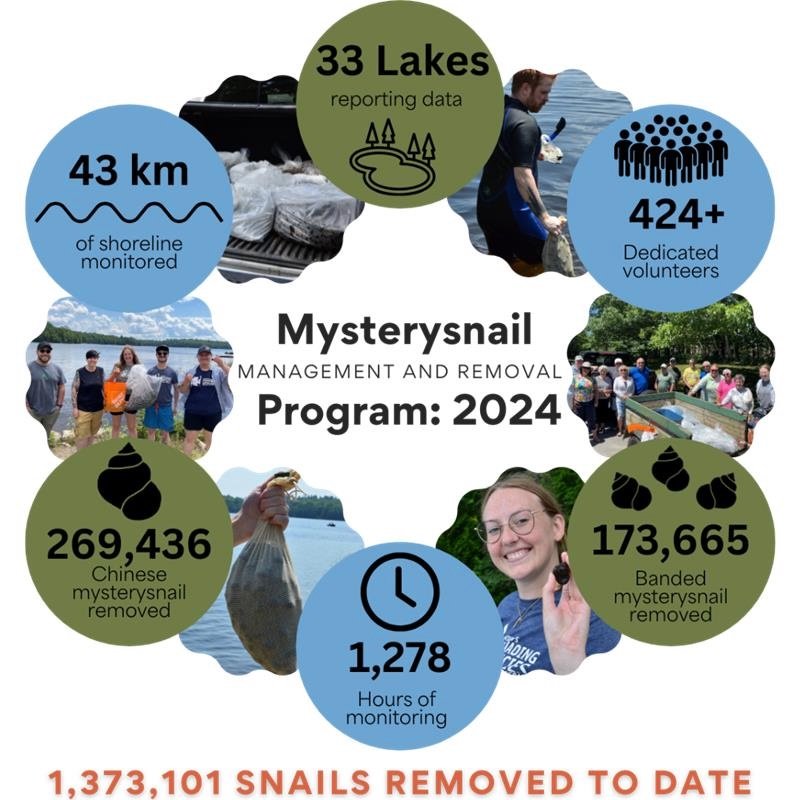
Mystery Snail Update: 2024
30 people on Boshkung Lake were licensed to collect invasive Mystery Snails in 2024.
For a copy of this year’s report, Click Here.
If you wish to join BLPOA’s Mystery Snail Team next year, please contact Lake Steward Jeff Woods at blpoa1@gmail.com. This is a great opportunity for high school students to gain volunteer hours while expanding their environmental and lake health knowledge.
BLPOA and CHA: Removal of Banded Mystery Snail
The Chinese Mystery Snail and Banded Mystery Snail are invasive species that’ve been introduced into our lakes.
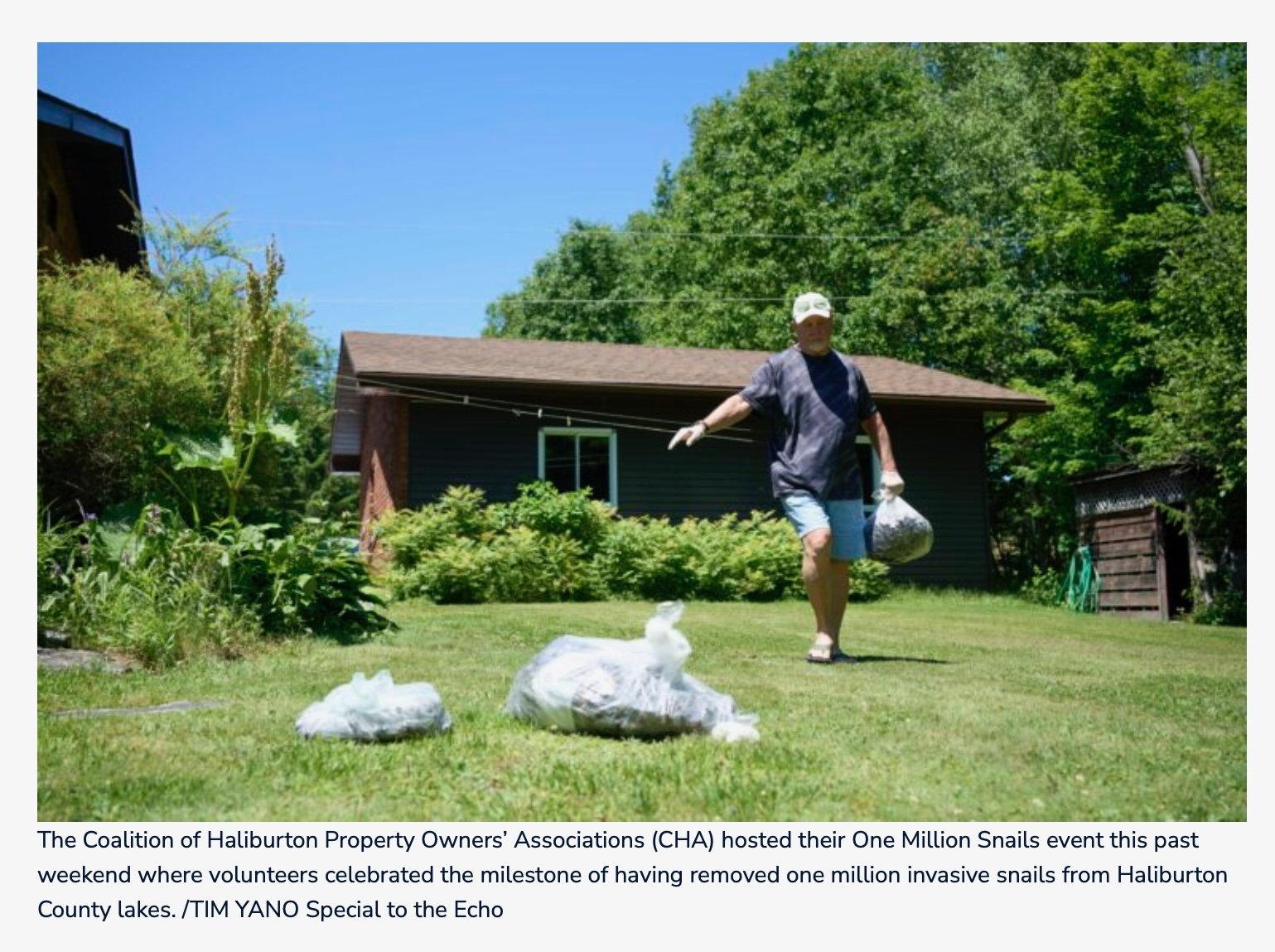
Through our participation with the CHA (Coalition of Haliburton Property Owners Association), our lake has 28 volunteers involved in this program and together they’ve removed over 1,000,000 snails from Haliburton County lakes.
Please see the recent article about it by Thomas Smith with The Echo at the link below or Click Here.
Boshkung Lake Property Owners’ Association is a member of the Coalition for Equitable Water Flow (cewf.ca), a local volunteer organization that works closely with the Trent Severn Waterway (TSW) in representing property owners on the reservoir system.
CEWF has produced the following two videos to explain why water levels are either higher or lower than normal and to assist property owners in preparing their waterfronts for the extremes of high and low water.
1. Understanding the TSW and Climate Change
2. Protecting Your Waterfront
During the BLPOA’s Annual General Meeting on Saturday, July 8th, 2023, we had the benefit of having Ted Spence, CEWF Chair, as our guest speaker.
In addition to showing the video Extreme Water Levels: What You Can Do, he discussed in detail the information in his Presentation to the BLPOA on July 8, 2023.
Sign up for Email alerts at the CEWF Website at: www.cewf.ca
View Drawdown Forecasts at: Current Drawdown Forecast
View Live Water Levels at: Trent-Severn Waterway water levels
BLPOA Supports the Coalition of Equitable Water Flow (cewf.ca)
Old Growth Forest in Haliburton Forest earns Historical Conservation Status

“A privately owned old-growth forest near Haliburton, Ont., is becoming the first in Canada to receive conservation status under a new special designation.
The South Freezy Lake old-growth forest is owned by Haliburton Forest and Wild Life Reserve, a logging company that supports forest conservation and sustainability by protecting some of its lands from timber harvesting and industrial activity. In collaboration with the Nature Conservancy of Canada, Haliburton Forest announced that it will designate its South Freezy Lake site as an Other Effective area-based Conservation Measure (OECM).”
Fire Prevention
Learn more about how to stay safe and protect the people and places you love by accessing the information available here:

Lake Health
Boshkung Lake is situated on the Canadian Shield with shallow acidic soils and granite substrata.
Contact the Boshkung Lake Steward for information regarding the water and soil health of our lake and surrounding area at:
Septic
Maintaining a healthy septic system is a high priority for all of us as we want future generations to enjoy the quality of our lakes and rivers as our families do today. BLPOA has been active in this initiative. Learn from the resources below.

Shorelines
BLPOA has been proactively engaged in creating awareness and programs that help all of us better understand how to be good stewards of our land and waters, including our shorelines.
